
HDB Renovation Cost in Singapore: Where the Money Actually Goes
30 Jul 2026 · YC Design and Build
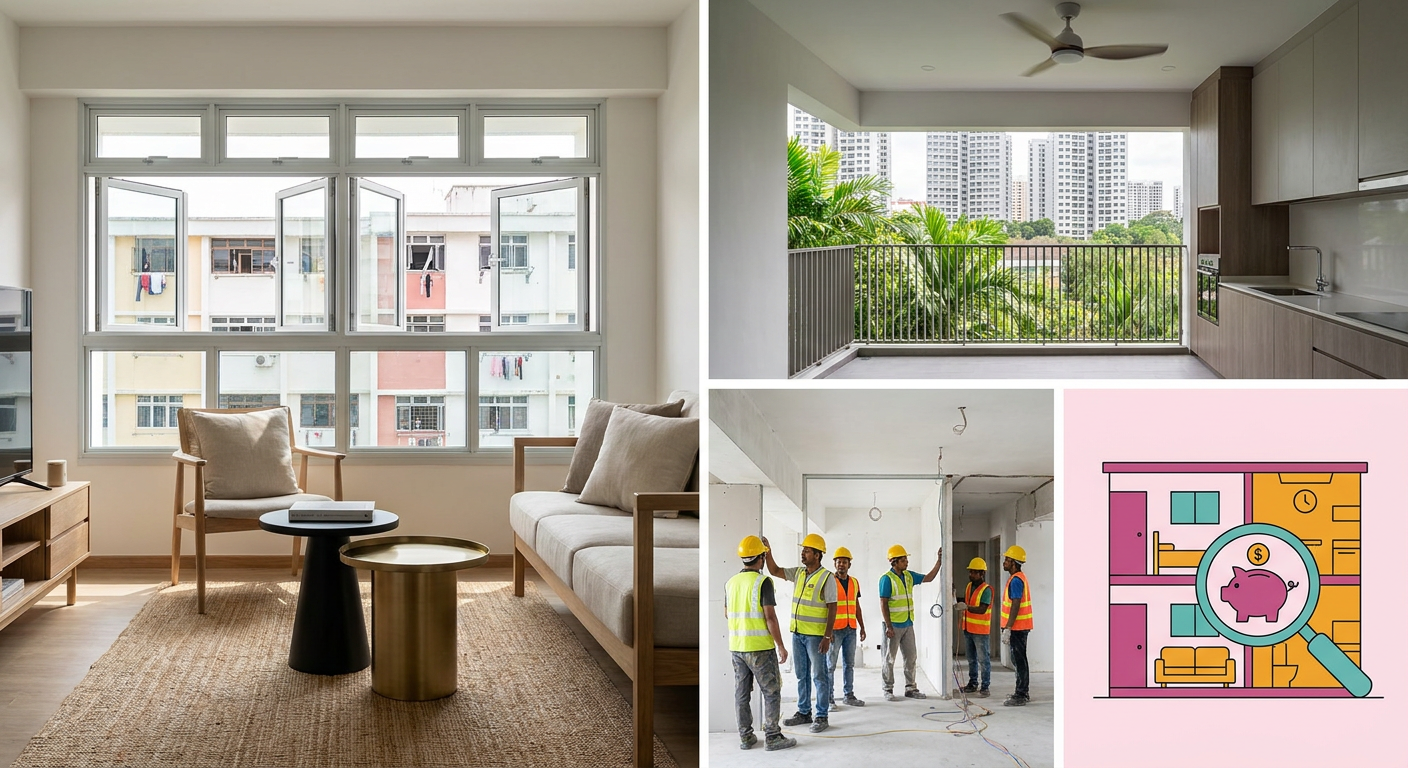
Renovation quotes hide the same few big line items. Here is what each trade actually costs and which decisions move your total the most.
HDB Renovation Cost in Singapore: Where the Money Actually Goes
Market rates for specific works, the labour sequence, and the HDB rules that shape what you can actually spend. Figures sourced from published Singapore renovation guides.
- Hacking floor tiles (per room)S$600 to S$1,000
- Cement screeding (whole flat)S$1,500 to S$2,500
- Laying tiles (per sq ft)S$2.50 to S$4.50
- Waterproofing (per area)S$500 to S$1,000
- Re-routing water pipes (per point)S$150 to S$300
- New toilet suite (labour only)S$300 to S$600
- Full rewiring (3 to 4-room)S$3,500 to S$5,500
- New power point (per point)S$70 to S$120
- New lighting point (per point)S$60 to S$90
- Kitchen cabinets (per foot run)S$150 to S$250
- Master bedroom wardrobeS$1,800 to S$3,500
- Feature wallS$800 to S$2,500
- Hacking and demolition, debris carted in bulk bags.
- Masonry and screeding to level floors and walls.
- Plumbing and electrical rough-in, concealed inside walls and floors.
- Waterproofing, followed by a 24 to 48 hour ponding test.
- Tiling, grouting, and flooring laid across the flat.
- Carpentry installation: cabinets, wardrobes, and shelving.
- Electrical and plumbing finishing: fixtures, sockets, and fittings.
- Painting, ceiling works, and final touch-ups.
- Avoid moving wet areas. Rerouting a sink or toilet bowl requires deep hacking and new waterproofing.
- Use standard tile sizes. Large format tiles cost more to lay and demand specialist tools.
- Optimise carpentry. Mix built-ins with quality freestanding pieces and open shelving.
- Stick to the initial design. Changes after hacking begins mean paying for the same work twice.
- Compare apples to apples. A suspiciously low quote often means subcontracted labour or hidden costs.
If you are planning to upgrade your flat, the first thing on your mind is likely the hdb renovation cost. In Singapore, there is no single answer to what a renovation costs because every floor plan and every family's needs are different. However, there are standard market rates for specific works, clear sequences of labour, and strict Housing and Development Board (HDB) regulations that dictate what can and cannot be done. Understanding how these factors interact is the best way to prepare a realistic budget.
At YC Design and Build, we were contractors before we were designers. Hacking, plumbing, electrical, tiling, and carpentry are done by our own workers, not subcontracted out. This means we know exactly where the time goes, what the block will and will not allow, and where the money actually goes. This guide breaks down the realistic costs of renovating an HDB flat in Singapore, from structural hacking to carpentry, so you can plan your project without financial surprises.
What is the Average HDB Renovation Cost?
It is difficult to give an average cost because a fresh BTO flat requires completely different work from a 25-year-old resale flat. A new BTO usually only needs overlays, minor plumbing adjustments, and new carpentry. An older resale flat often requires a full hack-down to the concrete substrate, rewiring, and replumbing.
Based on current market rates, here is a general breakdown of what you should prepare to spend:
| Flat Type & Condition | Estimated Cost Range | What This Usually Covers |
|---|---|---|
| New BTO (Basic) 3-Room to 4-Room |
S$25,000 - S$45,000 | Built-in cabinets, TV feature wall, minor plumbing for kitchen sink, vinyl flooring overlay, painting. |
| New BTO (Extensive) 4-Room to 5-Room |
S$45,000 - S$70,000 | Full-height wardrobes, complex feature walls, kitchen and bathroom carpentry, overlay works, minor hacking of specific walls. |
| Resale HDB (Moderate) 3-Room to 4-Room |
S$60,000 - S$90,000 | Hacking of floor finishes and old built-ins, replumbing, partial rewiring, new carpentry, new bathrooms. |
| Resale HDB (Extensive) 4-Room to 5-Room / EA |
S$90,000 - S$150,000+ | Full structural strip-out, complete rewiring, replacement of all sanitary pipes, new tiling, custom carpentry throughout. |
Source: ShopBack Singapore
Source: FixMove Singapore
Source: Qanvast renovation calculator
Note that Executive Maisonettes (EMs) and older flats with much larger square footage will naturally push these estimates higher, especially if structural walls are being reconfigured.
The Main Cost Categories
To understand your quotation, you need to understand what goes into each line item. The cost of a renovation is a combination of materials and the labour required to install or modify them.
1. Masonry, Hacking, and Tiling
Hacking and tiling are among the most labour-intensive and expensive parts of a renovation. If you are renovating a resale flat, you will likely need to hack the existing floor and wall tiles down to the bare concrete slab before installing new ones. Hacking involves breaking the concrete screed, which requires permits and creates a significant amount of debris removal.
After hacking, masonry work begins. This includes the "screeding" process, where a layer of cement and sand is applied to level the floor or walls before tiling. Tiling itself requires precise cutting and laying. The cost here depends heavily on the tile material and the laying pattern.
- Hacking floor tiles: S$600 - S$1,000 per room (including debris disposal).
- Hacking wall tiles: S$400 - S$800 per wall section.
- Cement screeding: S$1,500 - S$2,500 for an entire flat.
- Laying homogeneous or ceramic tiles: S$2.50 - S$4.50 per square foot (labour only).
- Overlaying existing tiles: Cheaper than hacking, but only possible if the existing tiles are completely intact. Costs range from S$2.00 - S$3.50 per square foot.
Source: ShopBack Singapore
Source: ContractorSG renovation cost guide
2. Plumbing and Sanitary Works
Plumbing is governed by strict HDB regulations. Only a licensed HDB plumber is allowed to alter plumbing positions. Moving a sink or a toilet bowl requires hacking through the concrete floor slab to access the drainage pipes, creating new junctions, and re-waterproofing the floor. Because of the risk of water leakage affecting your downstairs neighbours, waterproofing is mandatory and must be tested.
- Waterproofing (for bathrooms/kitchens): S$500 - S$1,000 per floor trap or water point area.
- Re-routing water pipes: S$150 - S$300 per point.
- Installing a new toilet suite (bowl, basin, mixer): S$300 - S$600 for labour, excluding the cost of the sanitary wares.
Source: ShopBack Singapore
Source: ContractorSG renovation cost guide
If you are renovating a flat that is more than 15 years old, we highly recommend replacing the concealed copper piping. Old pipes corrode, and replacing them during a full renovation prevents future ceiling leaks that would force you to tear down your new carpentry.
3. Electrical Wiring
Like plumbing, electrical work must be done by a licensed electrician registered with the Energy Market Authority (EMA) and HDB. For resale flats, if the existing wiring is more than 20 years old, full rewiring is not just a recommendation; it is a matter of safety. Full rewiring involves running new cables through concealed PVC conduits inside the walls and ceilings.
- Full flat rewiring (3 to 4-room): S$3,500 - S$5,500.
- Adding a new power point: S$70 - S$120 per point.
- Adding a new lighting point: S$60 - S$90 per point.
- Upgrading the DB box (Distribution Board): S$400 - S$700.
Source: ContractorSG renovation cost guide
Source: EMA
4. Custom Carpentry
Carpentry is usually where the majority of a renovation budget goes. Built-in cabinets, wardrobes, kitchen cabinets, and feature walls are custom-measured and fabricated. The cost is driven by the type of materials used, the complexity of the design, and the type of hardware (like Blum or Hettich hinges and drawer runners).
Most carpentry uses medium-density fibreboard (MDF) with a laminate finish, which is durable and cost-effective. Solid wood is rarely used for built-ins in Singapore due to the humidity, which causes warping.
- Kitchen cabinets (lower and upper): S$150 - S$250 per foot run.
- Master bedroom wardrobe: S$1,800 - S$3,500 depending on length and interior fittings.
- Feature wall (fluted panels, mirrors, or laminate): S$800 - S$2,500.
- Vanity cabinet for bathroom: S$600 - S$1,200.
Source: ContractorSG renovation cost guide
Source: Qanvast renovation calculator
5. Painting and Ceiling Works
Painting is usually the final step. For new BTO flats with pristine walls, a basic paint job might be included in the package. For resale flats, walls must be stripped of old paint, patched, and primed. If you want a completely flat ceiling without exposed beams, you might need to install a false ceiling (usually L-boxes or plasterboard).
- False ceiling installation: S$2.50 - S$4.00 per square foot.
- Strip and repaint entire flat: S$800 - S$1,500 for a 4-room flat.
Source: ContractorSG renovation cost guide
Source: HomeMatch HDB renovation costs guide
Permits and the Renovation Sequence
Any structural, plumbing, or electrical work in an HDB flat requires a permit. Your interior designer or main contractor will apply for this on your behalf. The permit application requires detailed floor plans, a list of works, and the licence numbers of the specific tradesmen doing the job. There is no way around this; unauthorised works can result in heavy fines and a mandate to reinstate the flat to its original condition.
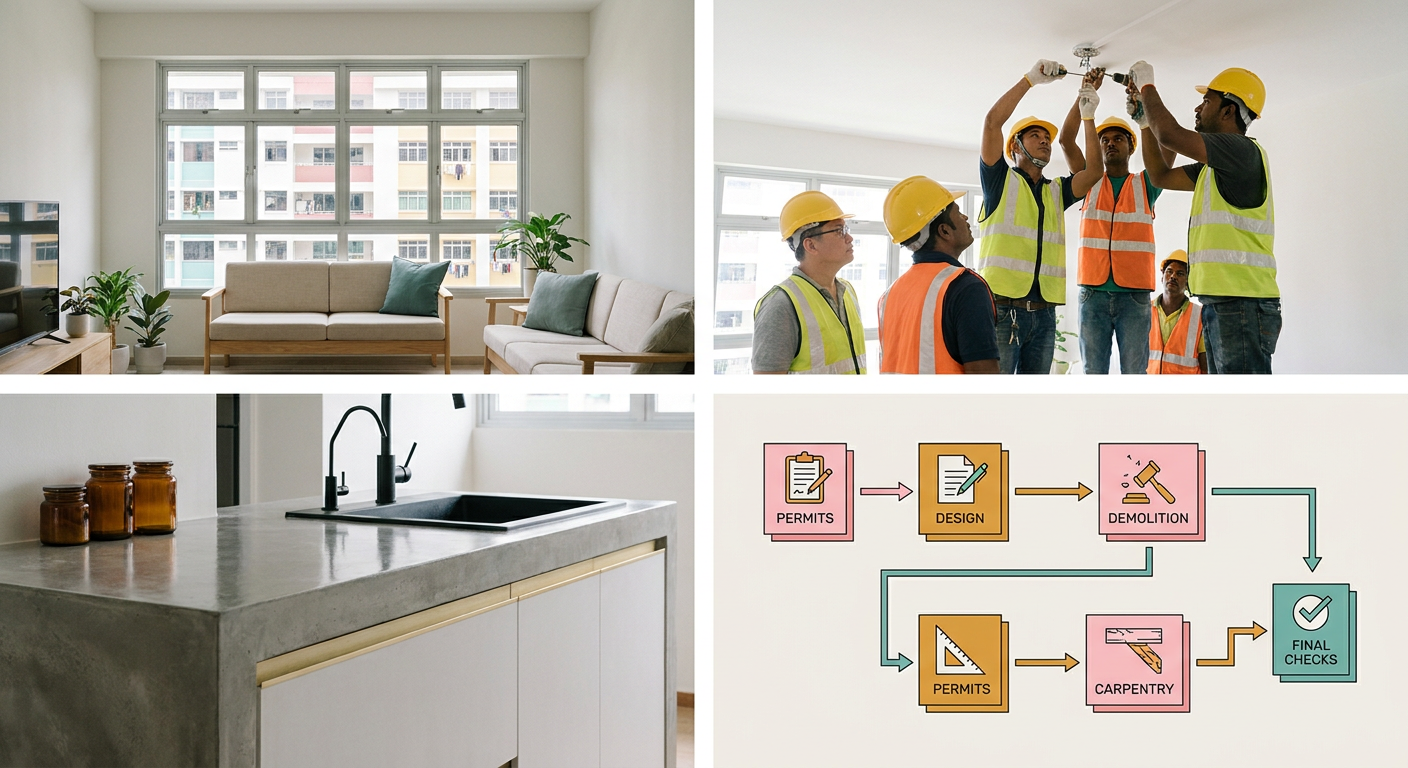
The sequence of works dictates the timeline. A typical renovation takes 6 to 10 weeks. Doing things out of order is the fastest way to ruin new finishes. A proper contractor sequence looks like this:
- Hacking and Demolition: Removing old tiles, built-ins, and non-structural walls. Debris is carted away in bulk bags.
- Masonry and Screeding: Levelling floors and patching hacked walls.
- Plumbing and Electrical (Rough-in): Running new pipes and cables inside the walls and floors before they are covered.
- Waterproofing: Applied to wet areas (bathrooms, kitchen, yard) and left to cure. A water ponding test is conducted for 24 to 48 hours to ensure zero leakage.
- Tiling and Flooring: Laying and grouting the floor and wall tiles.
- Carpentry: Installing kitchen cabinets, wardrobes, and shelving.
- Electrical and Plumbing (Finishing): Installing light fixtures, power sockets, toilet bowls, and taps.
- Painting and Touch-ups: Painting walls and ceilings.
Source: FixMove Singapore
Source: ContractorSG renovation cost guide
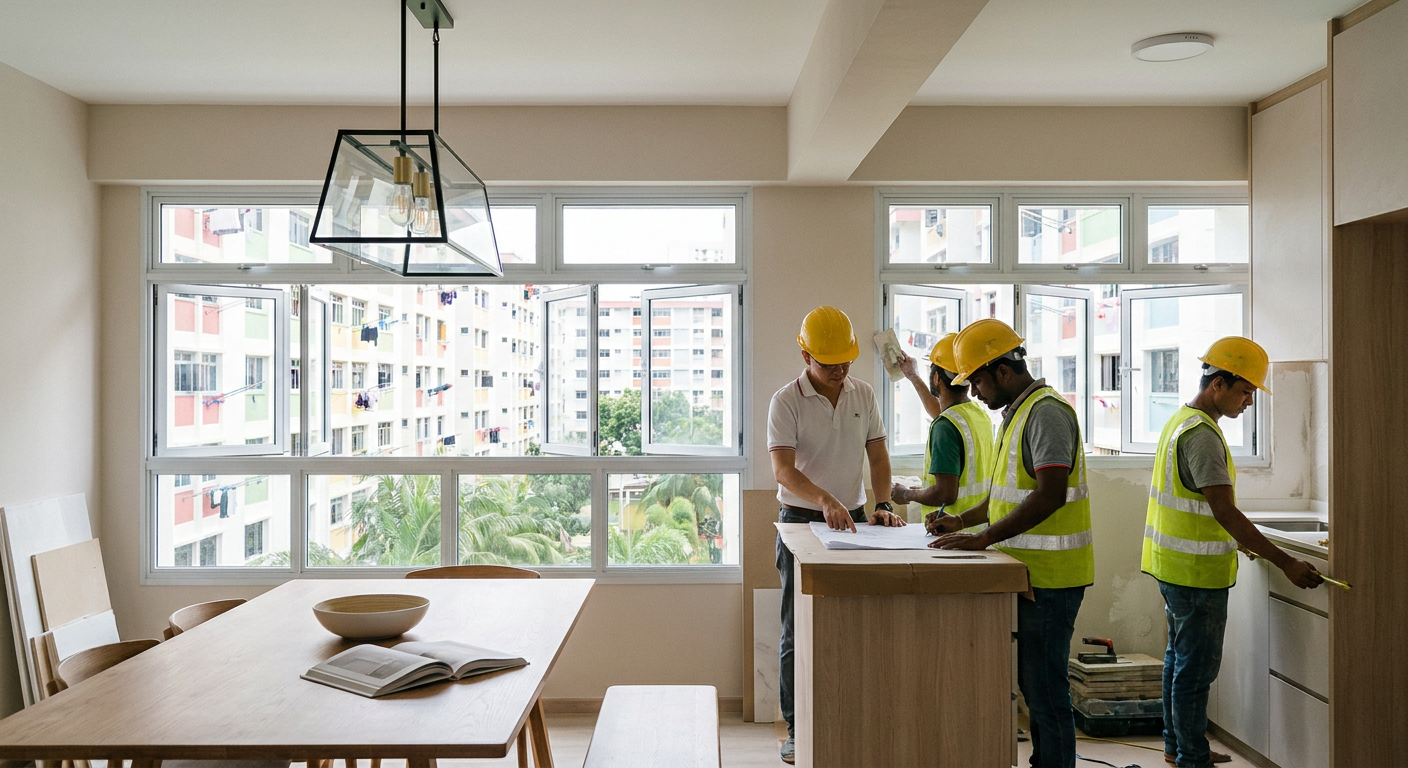
BTO vs Resale: A Direct Cost Comparison
The condition of your flat drastically alters the scope of work. Here is a direct comparison of what to expect.
| Factor | BTO Flat | Resale Flat |
|---|---|---|
| Starting Condition | Bare concrete with basic finishes already applied. | Varies; often has old tiles, dated wiring, and old plumbing. |
| Flooring | Can overlay directly if existing floor is level. | Usually requires full hacking down to the slab. |
| Electrical & Plumbing | New and compliant; usually only minor additions needed. | Often requires full rewiring and replacement of concealed pipes. |
| Permit Requirements | Generally lower; mostly for carpentry or minor works. | Extensive; required for all hacking, plumbing, and electrical works. |
| Estimated Timeline | 4 to 8 weeks. | 8 to 12 weeks (or longer if extensive structural reconfiguration is done). |
Source: ShopBack Singapore
Source: FixMove Singapore
How to Keep Your Budget in Check
Renovation costs can spiral quickly if you do not set firm boundaries. Here are practical ways to manage your budget without compromising structural integrity:
- Avoid moving wet areas: Moving your kitchen sink or toilet bowl requires deep hacking, new waterproofing, and pipe rerouting. Keeping them in their original locations saves thousands of dollars.
- Use standard tile sizes: Large format tiles (600x600mm or 600x1200mm) cost more to lay because they require a more careful levelling process and specialised cutting tools. Standard 300x600mm or 600x600mm tiles are the most economical to install.
- Optimise carpentry: Instead of building a full-height wardrobe in every bedroom, consider a mix of built-in and high-quality freestanding furniture. Use open shelving in the kitchen where you do not need concealed storage.
- Stick to your initial design: Making changes after hacking has begun is the biggest hidden cost. Moving a power point after the wall has been chased and plastered means paying for the same work twice.
- Compare apples to apples: When comparing quotes, ensure every contractor is quoting for the same scope of work, the same materials (e.g., plywood vs MDF), and the same type of hardware. A suspiciously low quote usually means subcontracted labour, lower-grade materials, or hidden costs that will appear later.
Financing Your HDB Renovation
Apart from paying in cash, there are specific financial pathways available for homeowners in Singapore:
Cpf Top-Up and Home Protection Scheme
You cannot use your Central Provident Fund (CPF) Ordinary Account savings to pay for general renovation costs. This is a common misconception. Renovation loans must be sourced separately.
Source: CPF Board
Renovation Loans
Most major banks in Singapore offer renovation loans. These are specifically designed for home improvement works and usually offer lower interest rates than personal loans. The loan amount is typically capped at a multiple of your monthly income or a fixed maximum (usually S$30,000), and repayment periods range from 1 to 5 years. The bank will usually require a renovation quotation from an HDB-licensed contractor before approving the loan.
Source: MoneySmart renovation loan guide
HDB Essential Maintenance
For older flats, HDB occasionally offers subsidised upgrading programmes, such as the Home Improvement Programme (HIP). This covers essential structural repairs and plumbing but does not cover aesthetic upgrades or custom carpentry. You must wait for HDB to offer this to your block; you cannot apply for it voluntarily.
Source: HDB Home Improvement Programme
Why a Contractor-Led Approach Matters
When you hire an interior design firm that subcontracts all its labour, you are paying for a middleman. More importantly, the designer does not control the schedule. If the tiling subcontractor is late, the carpenter cannot start, and your project drags on.
Working with a main contractor who has in-house workers solves this. Because we manage our own plumbers, electricians, and masonry workers directly, we control the sequence. This ensures accountability. If a pipe leaks after the tiles are laid, the same team that installed it will come back to rectify it, rather than pointing fingers between a designer and an outside subcontractor. This direct control also keeps costs down, as there is no markup added by third-party vendors at every stage of the project.
Frequently Asked Questions
Is S$30,000 enough to renovate an HDB flat?
Yes, S$30,000 is enough for a basic BTO renovation. This budget typically covers essential built-in carpentry (kitchen cabinets, a master bedroom wardrobe, a TV console), vinyl or laminate flooring overlays, minor plumbing for the kitchen, and painting. It is not enough for a resale flat that requires hacking and rewiring.
Do I need to pay HDB for a renovation permit?
There is no direct fee paid to HDB to submit a renovation permit application. However, you must engage an HDB-registered renovation contractor to submit the application. The costs involved are for the administrative work done by your contractor and the actual tradesmen's time to execute the approved works.
Can I renovate my HDB flat without an interior designer?
Yes. Many homeowners engage main contractors directly. This is known as "design and build." By going directly to a firm that handles both design and the physical labour, you save on the markup that a pure design firm would charge for outsourcing the construction work. You will still get space planning and 3D drawings, but the execution is handled by the firm's own workers.
How long does it take to renovate a resale HDB flat?
A full overhaul of a resale HDB flat typically takes 8 to 12 weeks. The first 2 to 3 weeks are spent on hacking and debris removal. Masonry and screeding require another 2 weeks, including time for the cement to cure. Tiling, plumbing, and electrical rough-ins take another 2 to 3 weeks, followed by carpentry installation and final painting. Weather and material delivery delays can extend this timeline.
What happens if my renovation damages a neighbour's property?
If your renovation causes water leakage or structural cracks in the flat below yours, you (the homeowner) are liable. This is why it is critical to engage a firm that strictly follows HDB waterproofing guidelines and conducts proper water ponding tests. A reputable contractor will have insurance and a warranty period to cover such defects.
Planning a renovation begins with understanding the numbers and the sequence of work. If you want to know what your specific floor plan will cost, bring it to our showroom. We will walk you through the actual labour and material requirements, step by step. Visit us at Blk 727 Clementi West Street 2, #01-278, Singapore 120727 (viewing by appointment), or WhatsApp Tony Chua at 9088 5037 to discuss your project.
Read next
- What cheap interior design costs in Singapore, line by lineCheap interior design in Singapore often shifts cost to variation orders, shortcuts and rework. Here is where the money usually goes.Costs
- What affordable interior design costs in Singapore, line by lineA plain guide to renovation costs in Singapore, broken down by trade so you can see where the money goes and what changes the total.Costs
- What cheap vinyl flooring costs in Singapore, line by lineA line-by-line look at what cheap vinyl flooring costs in Singapore, what changes the bill, and where the lower price usually comes from.Costs
Tell us what you are working with.
Send us the unit type and a rough idea of what you want done. We will come back with what it takes.